
How To Transplant Pepper Plants – Simple Guide

Disclaimer: As an Amazon Associate, I earn from qualifying purchases. Pepper Geek takes part in various affiliate programs. This means that purchases through our links may result in a commission for us.
Growing healthy pepper plants and big harvests comes from attentive care throughout the season. One of the most important processes is transplanting young pepper seedlings.
Transplanting is an important skill to master for growing peppers. Whether you start indoors, or buy your plants from the store, you’ll need to transplant them properly, and at the right time.
In this article, I’ll share my process on how to transplant pepper plants. It is very simple, but timing and technique are important to avoid damaging your plants or slowing down growth. Let’s get started!
Skip Ahead:
- What is transplanting?
- When to transplant peppers
- What you’ll need
- Step-by-step instructions
- Why not move straight to full-sized pots?
How To Transplant Pepper Seedlings (Video):
What Is Transplanting
Transplanting is the process of moving a plant from a smaller container to a larger one. This allows the plant to continue growing a larger root system. Without transplanting, your plants cannot reach their full potential.
Why transplant?
Keeping started plants in small pots for too long can cause a number of problems. The main issue is that the roots have nowhere to expand and grow.
This means that the root system will become entangled, or ‘root bound,’ making a later transplanting more shocking and disruptive to the plant’s health. This is why it is important to get the timing of your transplant right.
Another problem that can arise from not transplanting is stunted foliar (leafy) growth. Without transplanting, your pepper plants will likely grow tall and leggy without as many branches and leaves.
Stunted growth is caused by the root system’s inability to uptake the nutrients required to fuel a larger plant. This is why the size of your final planter will determine the maximum size of your pepper plant.
When To Transplant Pepper Seedlings
We often start our seeds in small seed cell trays, 6 plants per tray. About 3-4 weeks after sprouting, pepper seedlings should be ready to move into larger pots. After the plants begin to produce their 2nd or 3rd set of true leaves, they are ready to be transplanted.
Timing of planting and potting-up can vary based on the variety of pepper. Learn when to plant pepper seeds here.
For example, hotter peppers tend to grow slower, meaning the root systems may not develop as quickly as bell peppers or jalapeños. If your plants seem too small by week 4, give them an extra week before moving them into larger pots.
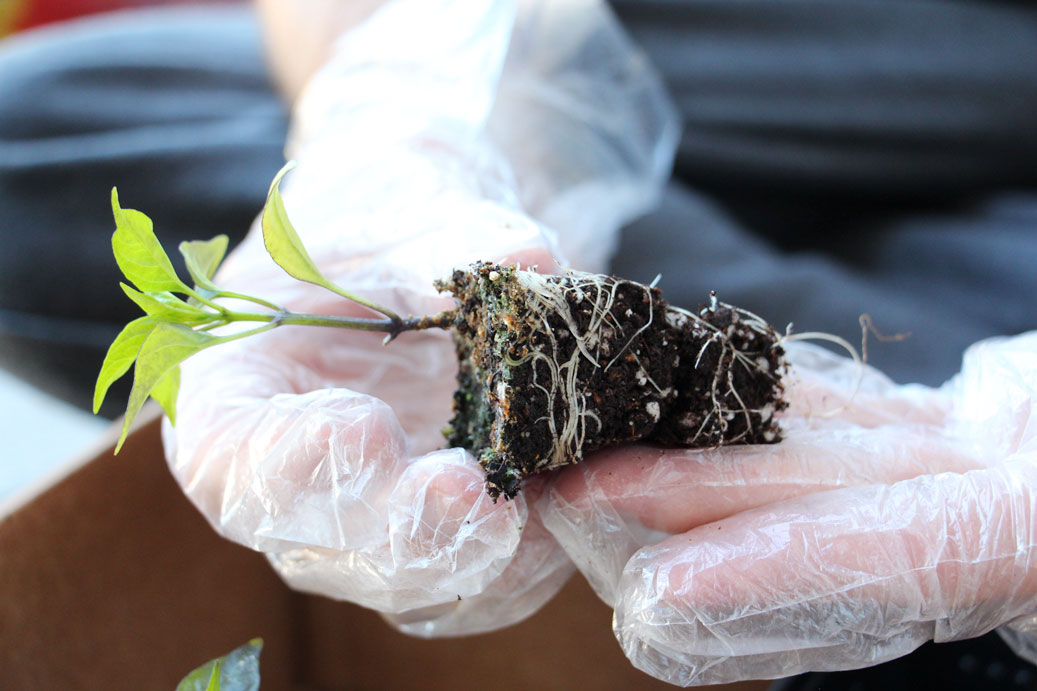
Tip: If you’re not sure if your plants are ready, peak at the root system by gently loosening the plant from the seed cell. If you can see a strong root ball with white roots all the way to the very bottom, your plant is ready to be transplanted. Ideally, you want to transplant before the roots start to coil.
Items You’ll Need For Transplanting
Transplanting is almost as simple as it sounds. You have your timing right, now all you need are a few items to ensure success. We’ve listed the items we use for transplanting our pepper plants, and where you can buy them online.
- Pots (3 Inch). These are the perfect size-up from seedling trays. They allow significantly more soil and retain water for much longer. You may also plant seeds directly in 3 inch pots, and transplant them directly into their final location from there.
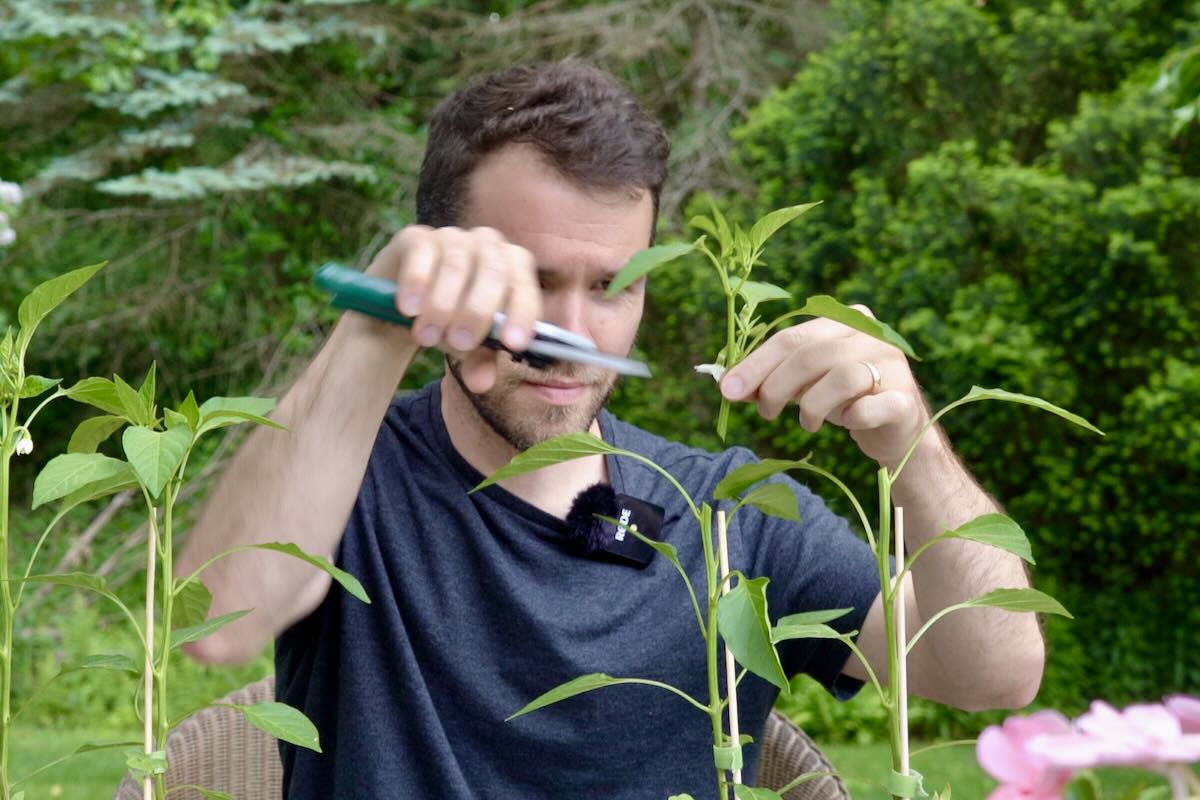
- Pruning shears. Pruning shears are used to cut away any additional sprouts at the base of their stem. Each seed cell should have just one plant. I have heard of some gardeners allowing multiple plants to compete in close proximity, but I’ve yet to experiment with this. I recommend just one plant per pot. Note: You’ll also want pruning shears if you plan to top off your peppers. Learn more about pruning pepper plants.
- Potting soil. After your seedlings have grown for 3-4 weeks, they are ready to handle nutrient-rich potting soil. The fertilizer in these soils is necessary for pepper plants to develop healthy foliage and structure during the early plant stages. If your plants have any nutrient deficiencies, you may notice signs such as yellowing leaves or curling leaves.
Other household items needed:
- Water
- Gloves (optional)
How To Transplant Pepper Plants
So you’re ready to transplant! Now it is time to take the steps to get it done. We prefer to get this all done in one go, but it can be back-breaking if you don’t have the right space for it.
What is a rootball? The rootball is the root system of your plant, the part of the plant that is below the soil surface.
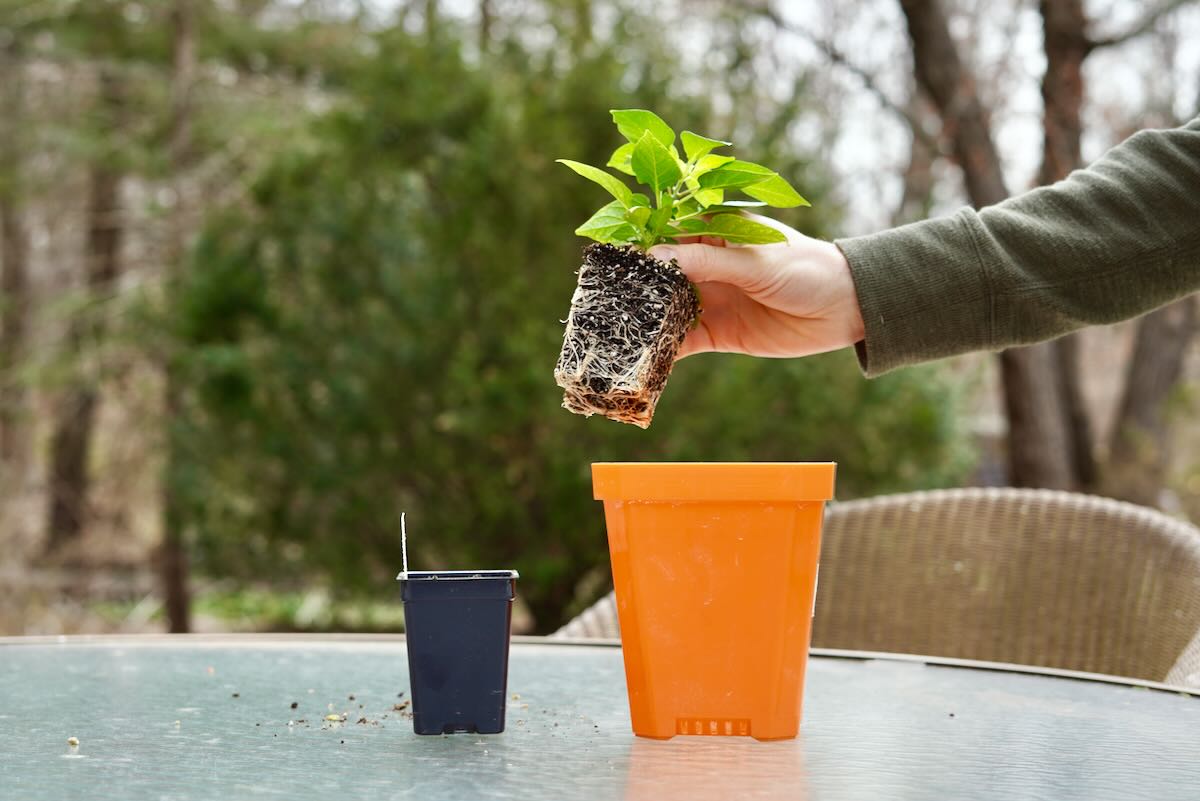
How To Transplant Pepper Plants (Steps):
- Get the required items.
Make sure you have enough larger pots (we use 3-inch pots when transplanting seedlings) and potting soil.
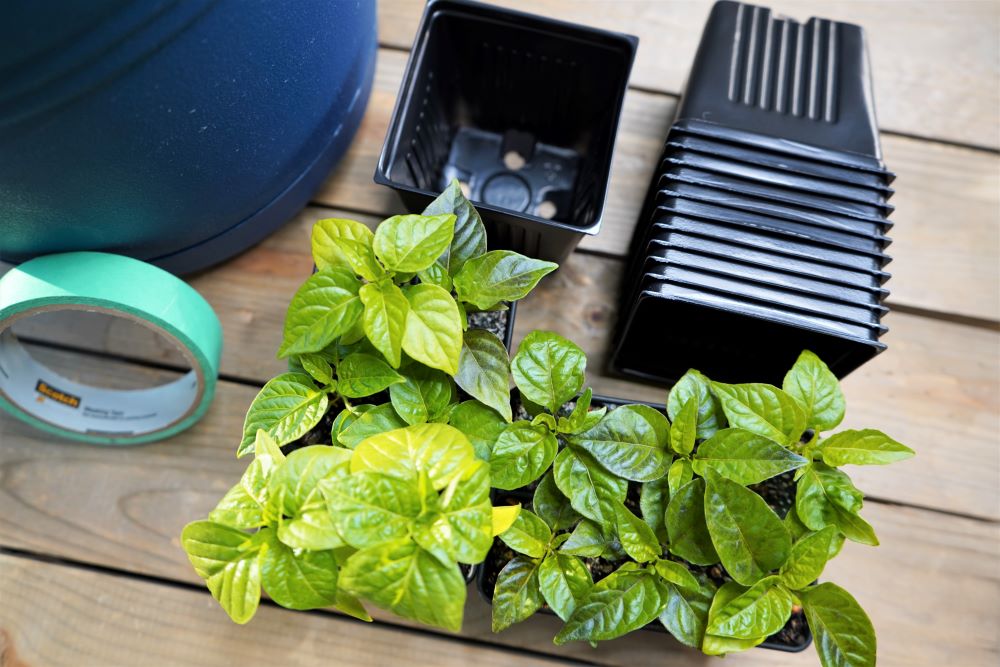
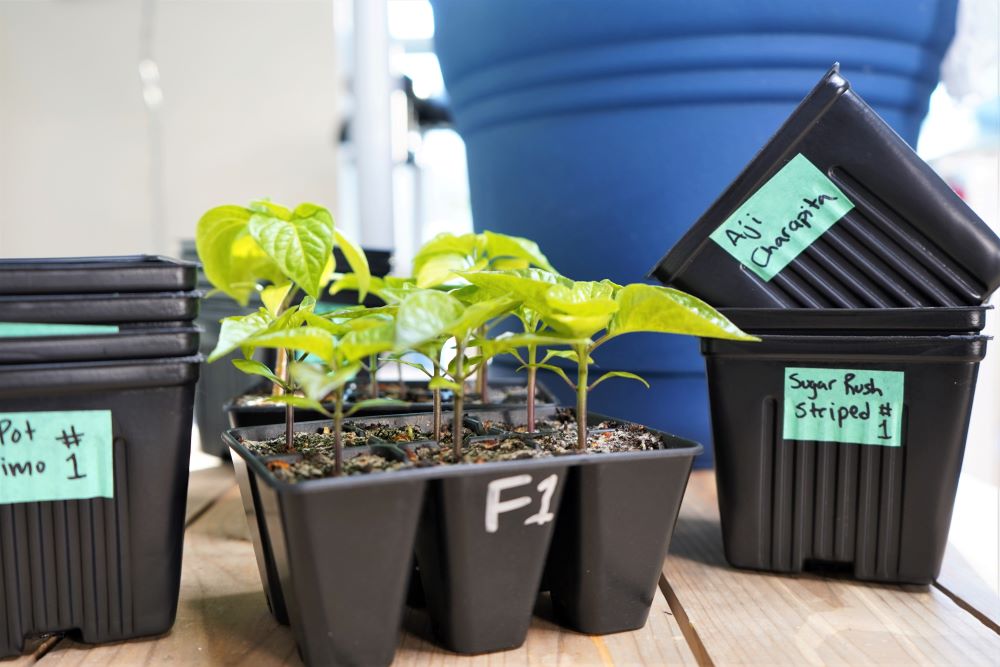
- Label new pots.
Organization is key! Don’t lose track of which plants are which. Use tape or a permanent marker to label each new pot with the plant variety.
- Prepare a work station.
Transplanting pepper plants is messy. Ideally, you should work outdoors. If you don’t have an outdoor space, put down some cardboard or newspaper to save your floors from a dirty mess. This can also be hard on the back if you have a lot of plants, so consider spreading out the work over multiple days.
- Pre-moisten soil
Start with a small amount of water and work the soil over to moisten evenly. Add water until it is just moist but not soaking wet! It should slightly stick together but not feel muddy. If it gets too wet, add more dry soil.
Tip: Use gloves to avoid dirty fingernails.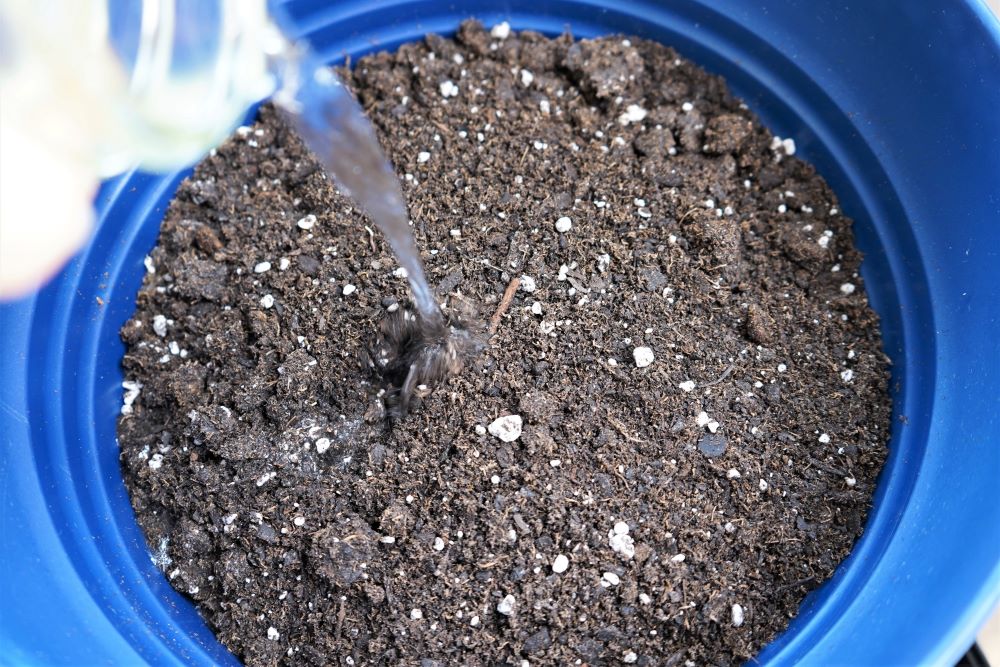
- Fill 3-inch pots with ~1 inch of soil.
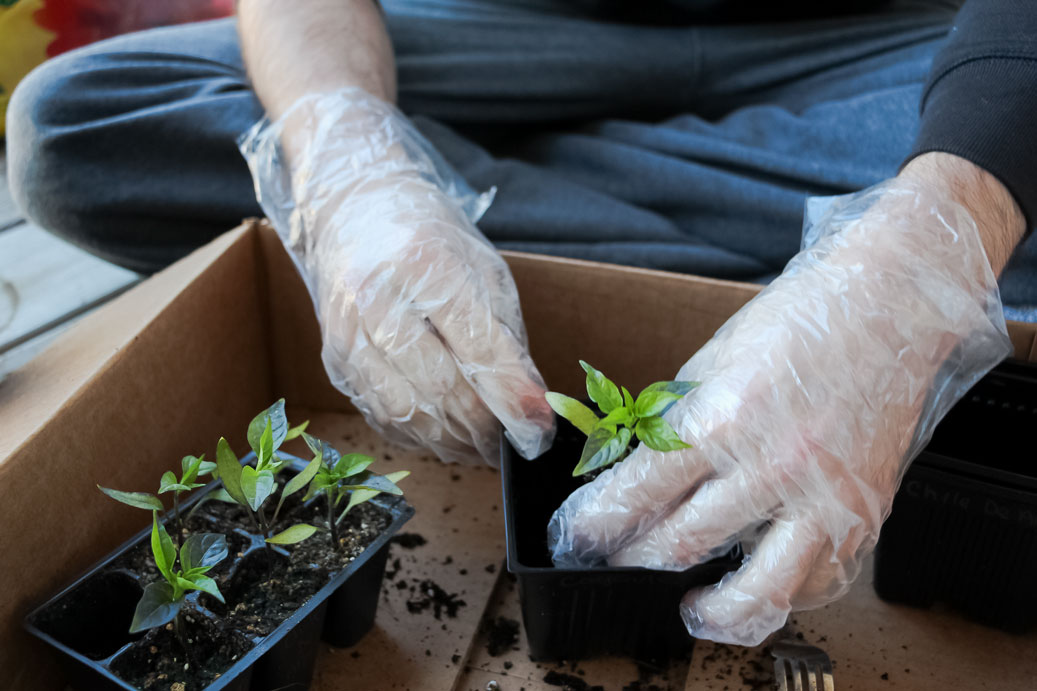
- Gently remove plants from seed trays.
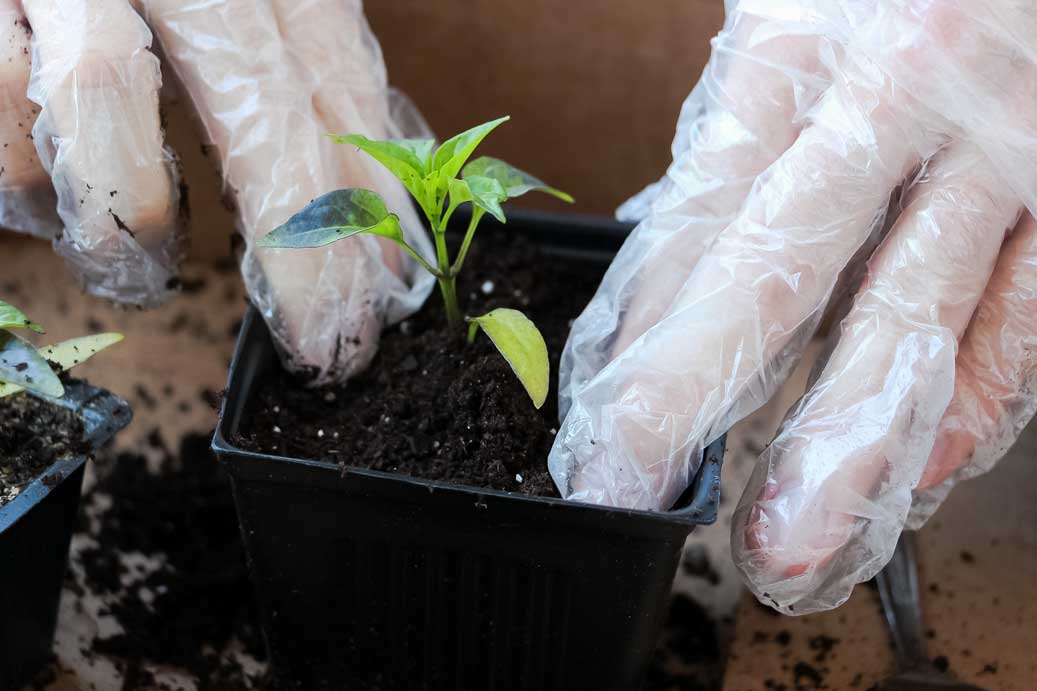
Loosen the plant by gently squeezing the seed cell on all sides. The plant can then easily be removed from the cell by turning the tray upside down and holding the plant by its upper foliage. Be careful not to damage the stem of each plant.
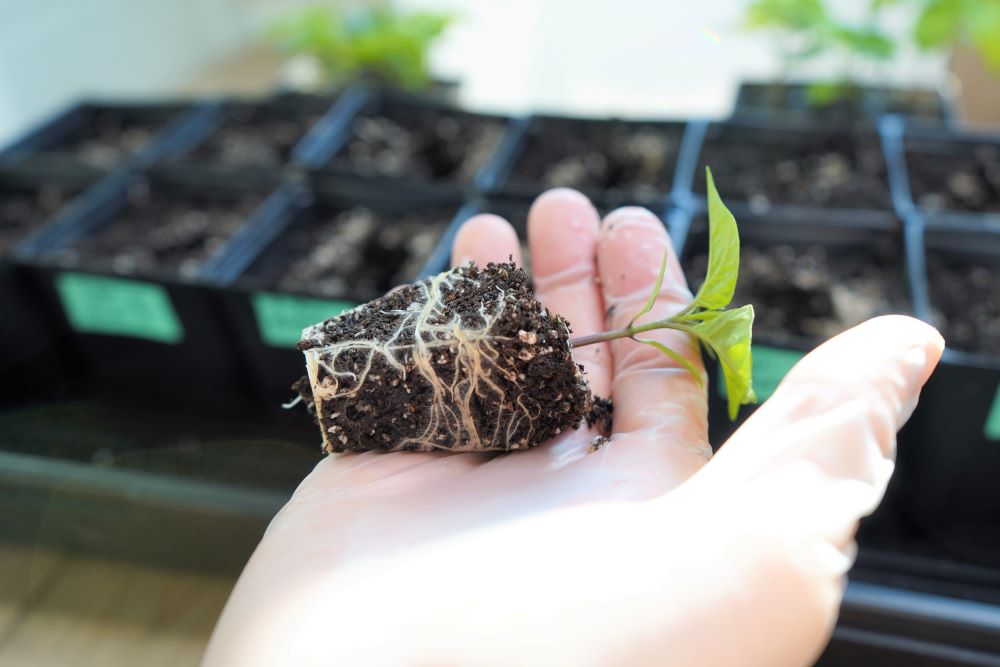
- Place the plants in new pots and surround with soil.
Allow the soil to surround the rootball naturally, filling in empty spots. Fill the pots to about 1/4 inch from the top. Avoid burying the plant’s main stem, planting at its original depth.
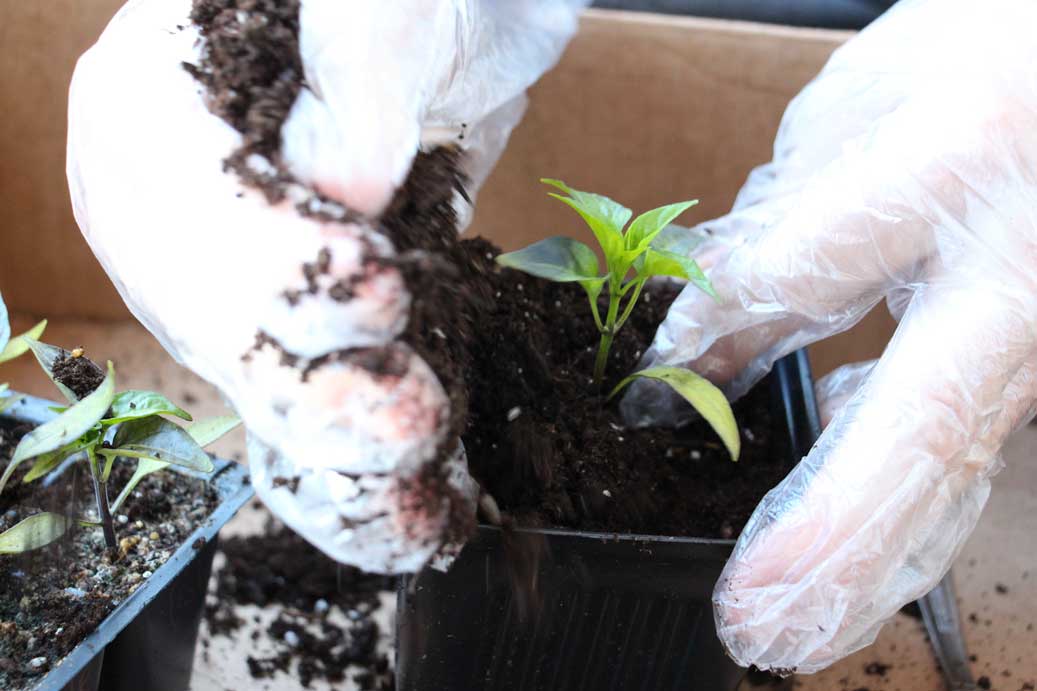
- Gently pack down the soil and top off.
Pack the soil gently with your fingers to ensure that there is good contact with the rootball. Top off with soil to keep the pots full.
- Water lightly.
To ensure each plant has a healthy transition, water lightly. This will join the old soil with the new and begin delivering nutrients to the roots.
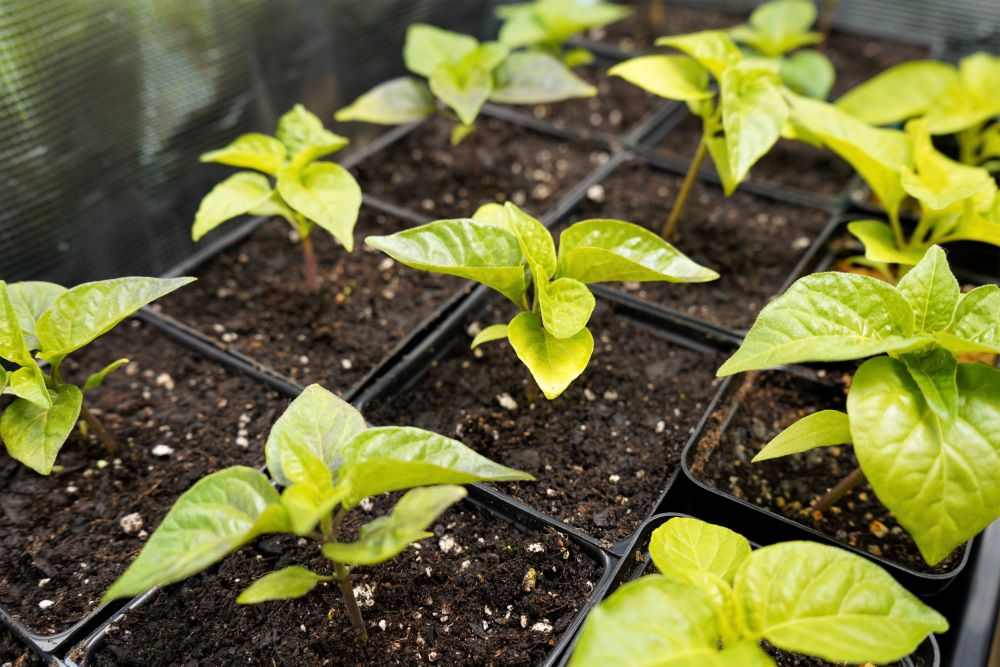
- Prune any additional plants.
If multiple seedlings sprouted in any of your seed cells, prune away the weaker plants with pruning shears, leaving one per container.
When Do I Move Peppers Into Large Pots?
One question we see a lot is, “Why not just move the seedlings into a large container?” There are a few reasons that we gradually increase the size of the container for the plants.
Indoor Space
The biggest reason to keep the young plants smaller pots is to save space. We grow many different pepper varieties each year (usually 50+ plants), and if we put each seedling into a 5 gallon pot, we would run out of indoor space before the weather was warm enough!
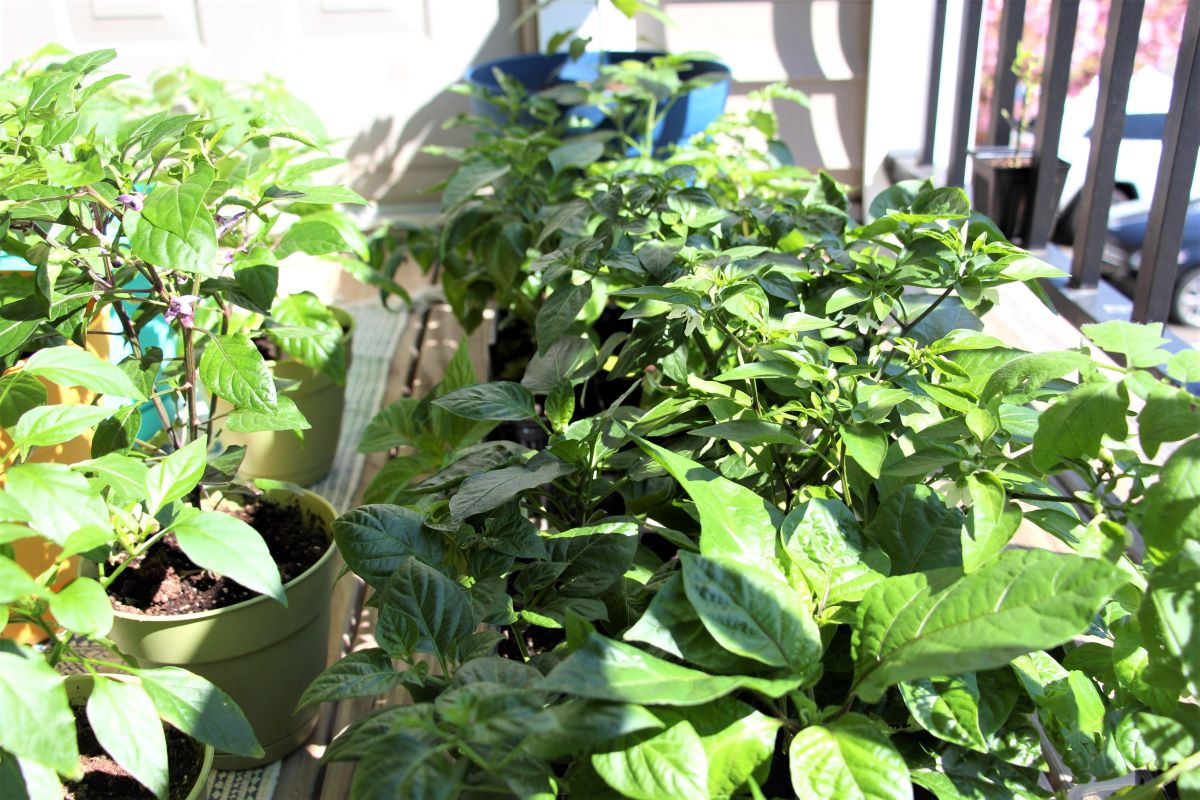
However, this doesn’t apply to all growers. If you only have just a few pepper plants to worry about, you may wonder if you can simply put the seedling-sized plants into their final pots right away. There is one other important reason that we would not recommend it.
Water Usage
When your pepper plants are small, they don’t drink too much water. However, a 5 gallon pot of soil will hold a lot of water that your plant is not yet large enough to use.
Without a large enough plant living in that soil to uptake the water, most of it will simply sit in the container. This moist environment in the unused soil is the perfect environment for other things to develop, such as mold and unwanted fungus.
By moving the seedlings into slightly larger pots, they will grow more quickly, and use the water within their pots more efficiently. The same is true for planting seeds – if you plant directly in a large pot of soil, the plants may grow more slowly.
The next step after transplanting is hardening off your pepper plants to acclimate them to the outdoor elements. Before you know it, you’ll be wondering when to pick your peppers!
I hope this guide helps you learn how to transplant pepper plants this year! Don’t hesitate to ask questions or reach out with any suggestions. Good luck!

Calvin
One of the original Pepper Geeks! When Calvin isn’t gardening or learning more about peppers and botany, he might be traveling new places or playing some music.
Ever experimented with mixing a little worm castings with soil when transplanting? Do you think it could potentially cause drainage issues if overused?
Worm castings are fine in moderation, I’d just recommend sticking to a set percentage. Pure worm castings don’t make a good soil medium in my opinion
@Alex, i use a handful in every pot, it won’t kill your plants
can i grow poblano peppers in tower garden
I prefer to give peppers a much larger container size, tower gardens are best for smaller plants that don’t require too much soil space. They also grow to be 3-5 feet tall, so supporting your poblanos out of the tower would be difficult!
How do I transplant an outdoor pepper plant that is thriving in a raised bed to a pot and move it indoors because of the cold temps? What kind of grow lights do I need to continue growing this beautiful plant.
Hope you found a way to overwinter the plant! It can be tricky to dig up an in-ground plant, but certainly doable!
Hi!. I never tried peppers before, but have an absolutely beautiful and fruitful hot banana pepper plant that I grew from a mixed bag of seeds. It’s about 3 foot tall and is constantly producing. I live in Tallahassee, so I know I’ll have to bring it in for a while (I have the lights) but should I also transplant it into a larger container than 5 gallons? Should I trim it back?
I’ve been married 36 years and if I still were not, I’d propose to this plant! hehe!
I want it to live and thrive!
Thanks for you outstanding advice!
John
Hi. I planted my beel peppers and jalapeños in the wrong soil for containers and so it doesn’t drain well. We had a large rain storm a week or so ago and it actually drounded 2 of them. My question is Can they be transplanted in the right soil and will they possibly survive? All leaves are wilted and dropping but the stem is still green. Please let me know and thanks,
Sandy
You could try, but I don’t know if they will handle it well, especially this late in the season. I would also check for drainage holes, as I’m not sure which type of soil would not drain at all unless there were no drainage holes
Hi Peppergeek,
I’m new to planting stuff, and I recently decided to deseed the sweet pepper I had bought from the supermarket, hmm, I had tons of seeds and a couple of pots outside with compost in. I’ve never been successful at growing things so I just threw the seeds in the 2 pots, covered them up with soil and gave them some water. They’ve lived outside from day 1 ( I live in southern Spain ) … so now I think every one of the seeds has germinated and I have lots of tiny plants growing in 2 pots !
I know I’ve got to move them into individual pots but I’m so nervous that I’ll kill them.
I’m so pleased that I’ve actually grown something from seed and would be devastated if they die when I move them
Please help 🙂
Sounds great! I would thin them down to 1 or 2 plants per container, and you can transplant the seedlings into individual pots. Just be carful to dig up the entire root system while causing as little damage as possible to the roots. Then surround them with soil in a new pot and water them in. Should take to the new soil pretty quickly if they are young and vigorous.
@peppergeek, thank you for your reply , I’ll give it a go and see what happens 😊
New gardener here; can’t thank you enough for all of your content!
I live in a 10a zone and grow all my plants on my patio, it get’s about 4-5 hours of direct sunlight a day. I have a jalapeno plant that I grew from seed (my first plant!). It’s sitting in a fairly large, raised bed. The plant is about 3 foot, 5 inches from the soil to the top further branch and is currently producing fruit (12 or so currently, all fairly close to being ready to harvest I’d say).
I would like to transplant it into a 5 gallon bucket (with drainage holes) so that I can use the planter for my herb garden, however not if there is a significant risk for damaging or killing the plant. Do you have any recommendations on how to approach moving a fully mature jalapeno plant (even if it’s just not moving it at all)? Thanks in advance!
If you have to move it now, I would expect some damage or die-back after the transplanting. Maybe harvest the pods, then transplant if you can wait. To do it, I would dig a circle around the main stem, at an 8″ radius (at least) to do as little damage as possible to the roots. Go as deep as you can as well. It will be impossible to get the whole root system (I’m sure it is very deep and wide at this point), but it can be done without killing the plant. Just expect it to be unhappy for a few weeks after the transplant!
@peppergeek, awesome, thank you for the response!
My plants have started to produce peppers. I want to know if it is ok to move them to a larger pot. Or should I just let them do their thing,and leave them alone.
It they are still small, you can upsize. Some of the fruits may drop after the transplant, but you should get a bigger yield later on if you have a long enough season ahead.
Without fail when I try to bring my pepper plants out for hardening off. They get stressed and wilt. It literally no joke took almost a month the last three years for hardening off. Granted I live in Chicago and it’s a little windy. But it’s only my peppers that go through this! Any advice I will take!
We were concerned with late transplanting but we were fearful of late frost. Currently, we have about 200 pepper variety in smaller pots and it’s been nearly 8 weeks.! We are going to transplant directly to field and say a little prayer.! Wish us luck
Wow, good luck to you! Maybe keep a few in just in case of disaster…or you could use floating row cover in the case of a cold snap.
I’m in zone 6b. When I transplant my seedlings to larger pots can I move them to my greenhouse? Do I need to keep them in house longer? I’m concerned with space but I don’t want to move my 3 inch pots out to the greenhouse to early.
Just be aware of temperature – avoid overnight temps below 55°F at all costs. The plants won’t die at that temp, but it may cause a setback in growth.
Hi,
I love the attention to scientific detail on your site. Here’s my question:
The 10-day forecast calls for 5 nights at 60º-55º, then 5 nights at 48º-51º.
I have seedlings I grew, and starts from the nursery.
Do you think it’s better to transplant now and let the plants suffer the 5 days of cold, or warm them indoors at night and sacrifice the 10+ days of potential rooting?
One source I found suggested that temps around 50º-55º encourage peppers to redirect energy to roots, making them shorter, and can train them to be cold hardy for the fall.
Any thoughts appreciated. I have two identical cayennes I will A/B test with.
Thanks,
Our plants endured 2-3 nights in the upper 40s this year, and no trouble. If you can cover the plants with anything insulating, it might be worth it, but probably not necessary. That temperature will not kill the plants.
@peppergeek, Thanks!
@HSHS,
Okay! A/B test results.
Hypothesis: temperature after transplant influences yield
Method: I planted Cayenne A June 8, Cayenne B June 24th.
Results: By the end of the summer, A = 28 peppers, B = 34 peppers.
So keeping the start warm indoors helped marginally. The indoor pepper (B) produced more peppers early in the summer. Outdoor (A) was ready to harvest a month later. The outdoor pepper plant was still flowering and eager to keep going as the weather turned, so maybe the roots did end up a little hardier.
I have a tiny, sloped growing area, so no two plants get identical conditions.
Conclusion: growing plants is fun.
😄 Thanks for sharing those results, doesn’t have to be a perfect experiment with tons of plants for it to be fun and interesting!
I have successfully started and am growing my pepper plants, to the point they are producing fruit. They need to be transplanted to a larger pot. Will I lose the fruit by transplanting?
Yes you should be able to transplant without losing fruits. It is possible if you damage the roots too much or otherwise cause a lot of stress.
Hello,
I just transplanted my peppers from 4″ to 5 gallons.
Admittedly, they were all possibly root bound (roots did not look awful) as we had a cooler May and I was busy the last couple weeks so they had to wait.
I think I also rushed the hardening off process a bit (5 daysish), but they were handling direct sun decently so I figured it was time. Stems are strong from indoor fan. But still windy and humid in my garden.
2 days after transplanting, 4 plants (2 jalapenos and 2 bell’s) have lost all or 90% of their leaves…
Others seem to have soft leaves and drooping mid-day but hanging in there. Worried the same demise will come…
I think I overwatered initially when transplanting? I figure since I was using grow bags that I could kind of drench the soil when I planted. Likely the cause? Very hard to tell if they need more water. Top inches still feel moist. No idea how it is near the bottom.
Any other ideas?
Will the plants that lost all leaves bounce back ok or should I scrap them and plant something else?
Correction to some of the information below. Some of the peppers (primarily Jalapenos) are 3 – 4 inches tall with 3 sets of true leaves, other peppers (sweet and hot) are 2″ tall with at least 2 sets of true leaves and then some others (sweet and hot) are a mere 1″ tall with 1 set of true leaves, but roots at bottom of pot.
For years I have successfully grown beautiful peppers – hot and sweet, until this year. I am not sure what went wrong this year. I started seed indoors, on heating mat, in 50 cells, mid-March, so about 4-5 weeks ago. I potted up to 2″ pots maybe a little late, a little over a week ago, they are growing very slowly. I recently moved them to a small greenhouse I can heat to 10 degrees above outside temperatures and I have started hardening off for the last couple of days outside and they seem to be improving since doing this. Our temperatures are to be upper 70/low 80’s for the next week, low’s mid-50’s, and several days were high drops to low 60’s and the low’s to low 40’s. The peppers are ready to be potted up again (they are not root bound, most are about 4″ tall, some less, all have 2-3 sets of true leaves, just growing very slowly. My question is: should I just go ahead and transplant them now versus potting up when I normally would put in the ground in another week, maybe two. Thanks
Hello there, peppergeek. I have a bit of a stupid situation maybe and I could use some help with advice and troubleshooting. I have a pretty old Scorpion chilli plant that I’ve kept in my apartment windowsill for a few years now. I grew it from a seed. I love it very much. He is pretty much a part of the family. I’ve re-potted it a couple times, but I believe it now lives in a pot which is many sizes too small. It is a 4′ 9″ tall tree in a 7″ diameter pot. Impressive, I know. I water it every single day with a hydroponic fluid so it can get enough water and nutrients to drink. If I skip a day, it can start to wither. It actually looks very healthy, with a luxuriant mane of vibrant green leaves and many flowers, though I have much trouble getting them to make fruit, even with trying to pollinate with a little paintbrush. I think maybe it doesn’t want to grow any fruit because the pot is too small? I want to replant it, but I am worried it won’t be able to stand up again after I do that or not survive the trip. I also don’t know anything about pruning or anything like that.
So, how replant and why no fruit and what do?
Hi!
I have a question about a one year ole plant that I kept in a smaller pot last season and potted up to transplant in ground this spring. The problem is that the plant is now top heavy and starting to bend.
My question is this. I’ve heard that peppers will send out roots from the stalk if you bury them deeper in the ground. Is this true? And if so is this true for older peppers as well? If so how deep should I plant it?
Hi Troy, I would not recommend burying a pepper’s trunk in the soil. While peppers will eventually shoot out adventitious roots, they do not do it quickly. As a result, you may just end up with a rotten stem which can harm the plant.
Instead, I’d recommend staking the plant with bamboo or any sturdy stake. This will keep the plant upright until it develops a more robust root system.
I bought some of my plants from the nursery since my cat knocked my seedlings off my bench so now I have to replant my seeds
The plants have leaves growing down the stem close to the ground and I’m wondering should I clip them off before I plant them? I’m afraid that they will just attract pest or just rot. What do you think?
I’ve been told that peppers hate to have their roots disturbed and that transplanting should be minimized. How many times do you transplant your bell peppers before they reach maturity? I’m definitely rethinking the whole pepper planting process & I enjoy your videos & articles! Thanks!
We transplant our plants twice – once from seedling cells into 3.5″ pots, and once more into either large pots, or into the ground. The roots are actually pretty resilient in our experience.